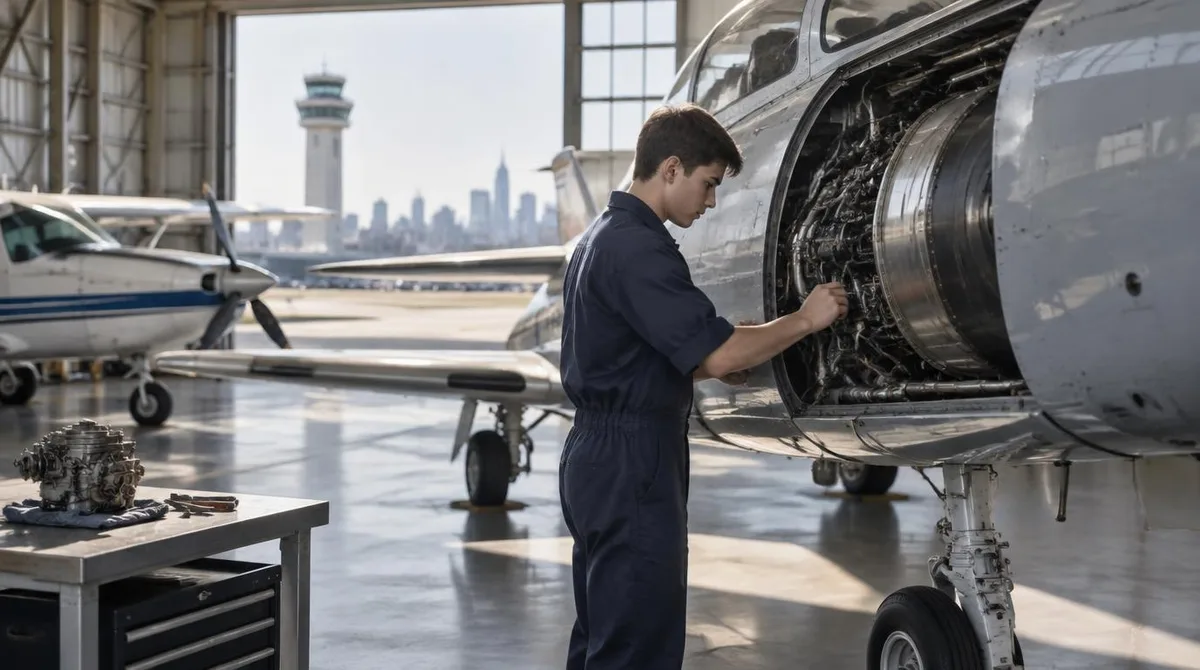
Aviation High School is a public high school in New York City that teaches aircraft maintenance alongside a regular academic curriculum. Students take English, social studies, and physical education, but their timetable also includes technical courses on ground operations, carburettors, magnetos, and jet engines. The school sits at John F. Kennedy International Airport, and its building contains a hangar with 17 aircraft that students use as training equipment.
What makes the model worth attention is how directly it connects a high school schedule to a licensed trade. Over four to five years, students inspect, maintain, and repair real components, and they work toward Federal Aviation Administration licensing before they graduate. According to Yahoo, the school has been preparing students for careers in the aviation industry for 81 years. That track record matters for anyone weighing whether career and technical education can lead somewhere concrete.
For readers tracking careers that start before college, the school is a useful case study. It shows a pathway where the credential, the equipment, and the employer-adjacent setting all sit in one place — something most high schools cannot replicate, but whose structure others can borrow. Readers following this should also see Careers for Kids — Exploring Careers With Kids: Turning Curiosity Into Real Plans.
How does a school teach aircraft repair to teenagers?
The answer is a split schedule. Students keep their regular academic classes, then add technical coursework on how aircraft systems operate. The instruction is not simulation-based. The hangar inside the main building holds 17 aircraft, and students work on them directly, learning the machinery, tools, and procedures professional aircraft mechanics use.
One student, Martin Sienczuk, described a classroom that extends beyond desks and whiteboards. He regularly works around real aircraft, learning how different systems operate and what it takes to keep them safe in the air. The program runs four to five years, which gives students time to move from basic familiarity to genuine inspection and repair work rather than a single introductory course.
Why does the FAA licensing piece matter so much?
Because it turns coursework into a credential. Students work toward the qualifications needed to pursue aircraft maintenance careers, including licensing through the Federal Aviation Administration. That means a graduate can leave high school with a recognized professional pathway already underway, not just an interest in the field.
This is the detail other career pathways often lack. Many high school programs offer exposure — a class, a club, a visit. Aviation High School offers progression: years of practice, real equipment, and a licensing step that the industry itself recognizes. The school's own framing, as reported, is a pathway from classroom learning into the professional aviation industry.
What does the work actually demand of students?
More than most classroom subjects. Every component of an aeroplane must be inspected carefully to confirm it is properly installed and functioning as intended. A loose screw, an unsecured wire, or an improperly fitted bolt can create serious safety risks. The stakes are not abstract.
When a mechanic signs off on a completed repair or inspection, that signature is professional approval for the aircraft to return to service. An aircraft can carry more than 100 people, and every passenger depends on the technicians who maintain it. Teaching teenagers that standard — that their signature carries that weight — is arguably the most demanding part of the curriculum, and the hardest thing to fake in a purely academic setting.
Sienczuk told the outlet that his greatest satisfaction comes from working with his hands and seeing the results. Watching an aircraft fly after contributing to its maintenance connects his education directly to the real world. That kind of feedback loop is rare in high school, and it may explain why students stay with a demanding program.
What should other schools and career-changers take from this?
Three structural features stand out. First, longevity: 81 years of running the same specialized mission suggests the model survives budget cycles and leadership changes. Second, authentic equipment: 17 aircraft in the building means students practice on the machinery they will actually work with, not a stand-in. Third, an external credential: FAA licensing gives the training an industry-recognized endpoint.
None of this is easy to copy. Most schools cannot site a campus at a major airport or house a hangar. But the sequence — sustained coursework, real equipment, a recognized certification — is a template any career and technical program can measure itself against. Similar questions about how classrooms connect to real career paths come up in a Nashville art program that shows two career paths in one classroom, and for younger students, turning curiosity into real plans starts with the same principle: let students touch the work. We covered a connected angle in Education: A Nashville Art Program Shows Two Career Paths in One Classroom.
The limits are worth stating plainly. The evidence here describes one school's program and one student's experience; it does not include outcome data on graduation, placement, or licensing pass rates. Families considering a similar pathway should ask a school directly for those numbers. What the available reporting does establish is that a public high school can run a licensed-trade pipeline inside a standard school day — and has been doing it for eight decades.