Adaptive learning software adjusts what a student sees next based on how they just performed — answer three fraction problems correctly and the difficulty rises, struggle and the system inserts easier items or a hint. That adjustment engine, not any particular subject or brand, defines the category. It is now embedded in math and reading intervention products used across thousands of U.S. districts. The honest research picture is mixed: some well-designed studies show meaningful gains in specific settings, while large-scale district evaluations frequently find effects that are small or depend heavily on how much students actually use the program.
How does an adaptive system actually work?
Most products build an internal estimate of each student's skill, often drawing on psychometric models developed over decades of testing research, and then select content targeted just beyond current demonstrated ability. The better systems vary item difficulty, sequencing, and scaffolding — hints, worked examples, or prerequisite review — rather than only pacing. The distinction matters for buyers: some products marketed as adaptive merely randomize quiz order, which is personalization in name only. A useful procurement question is to ask the vendor to explain, in plain language, what the engine adapts and on what evidence the decision rules were built.
What different designs do districts encounter?
| Design | What it adapts | Typical use |
|---|---|---|
| Computer-adaptive testing | Item difficulty during an assessment | Interim and diagnostic testing |
| Adaptive practice | Sequence and difficulty of exercises | Math fact fluency, vocabulary |
| Intelligent tutoring systems | Step-by-step feedback within complex tasks | Algebra, computer science |
| Adaptive courseware | Whole instructional path including content | Self-paced credit recovery |
What does the research base actually show?
The strongest evidence exists for focused, well-implemented systems. Intelligent tutoring research from teams at Carnegie Mellon, where the cognitive tutor line of work began, has repeatedly shown results approaching one-on-one human tutoring in controlled studies, a finding summarized in the broader education-technology meta-analysis literature. Federal evidence reviews through the Institute of Education Sciences' What Works Clearinghouse have found some math intervention programs with positive effects while finding weak or no effects for others, which is the central lesson: category labels do not predict outcomes, specific products with specific implementations do. Randomized evaluations of widely deployed math software, including work by researchers at major universities studying district deployments, have found that usage time is a decisive variable — fifteen minutes a week rarely moves achievement, while sustained scheduled use sometimes does.
Where did adaptive learning come from?
The idea is older than the web. Psychologists working on programmed instruction in the 1960s built branching paper materials that moved learners forward only after correct responses, and computer-assisted instruction systems of the 1970s computerized the same logic. The modern era began when item-response theory from standardized testing met large digital item banks, allowing systems to estimate ability from fewer questions and select the next item statistically. Intelligent tutoring systems then added cognitive models of how students err in specific domains such as algebra. Knowing this lineage helps evaluators ask the right question: not whether adaptation sounds impressive, but what model of student knowledge sits underneath and whether it has been validated in the domain being taught.
Why do results vary so much between districts?
Implementation explains much of the variance. Adaptive software is frequently purchased as a supplement that competes with nothing and replaces nothing, so it gets scheduled inconsistently and quietly drops off. Where districts carve out a protected intervention block, assign the program as the core of that block, and have teachers review the dashboard weekly, results tend to be substantially better. Teacher knowledge matters too: the software identifies gaps, but a human still has to act on them. Evaluations also repeatedly show effects concentrated among students who use the program as designed — an obvious point with uncomfortable procurement implications, since a product that students avoid using has no mechanism to work.
What are the honest limitations?
Four limitations recur in the literature. First, outcome measures are often narrow — a within-program assessment is not an independent test of learning, and vendor-selected metrics deserve skepticism. Second, most studies are short, spanning a single semester or year, while districts buy multi-year licenses. Third, effects on motivation are understudied even though engagement is the delivery mechanism for any benefit. Fourth, adaptive systems optimize toward their own model of the skill, and when that model is thin — as it can be in writing or higher-order reasoning — the personalization is shallow. This is why serious district evaluations pair vendor dashboards with independent measures such as state assessment results.
How should a district evaluate a specific product?
- Ask for the strongest study the vendor can offer and check who ran it, on what sample, and against what comparison group.
- Check the federal What Works Clearinghouse and Institute of Education Sciences evidence reviews for the product or its closest category.
- Define usage expectations in the purchase decision — minutes per week, protected in the schedule.
- Pilot with a comparison group of schools where feasible, using an external outcome measure agreed in writing.
- Review usage data monthly during the pilot, not only at the end.
How does adaptive software fit an intervention block?
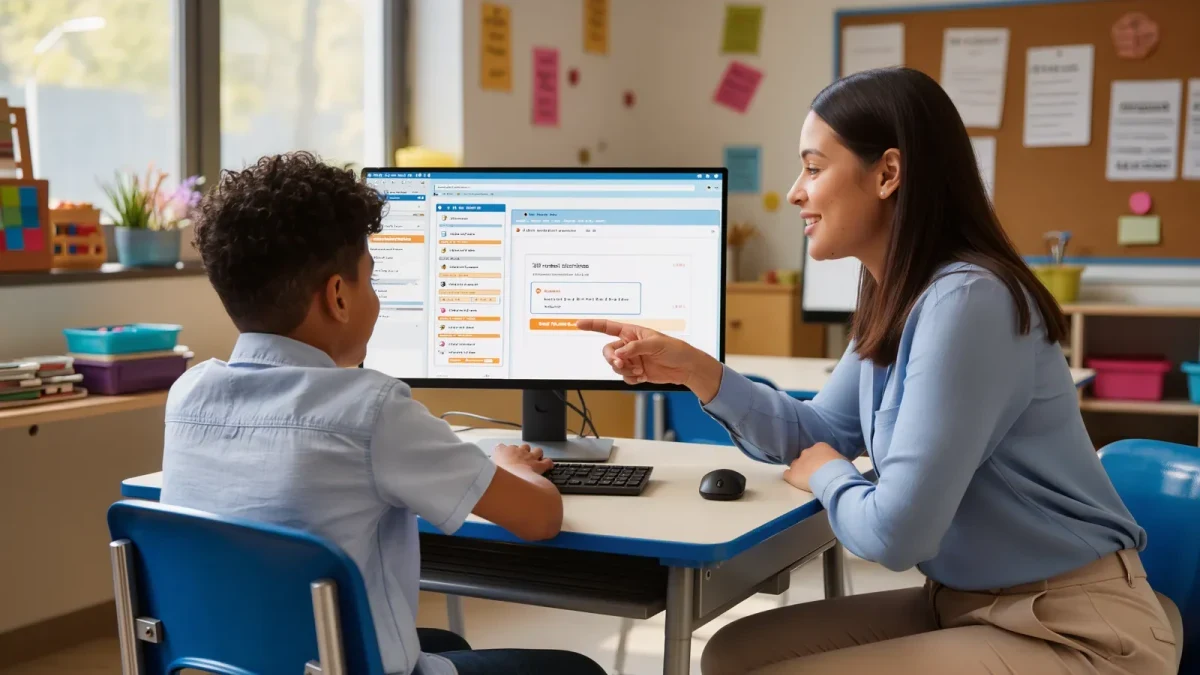
The most common deployment is a scheduled intervention or enrichment period in elementary and middle schools, where the platform differentiates practice across a wide ability range while the teacher works with a small group. Done well, the teacher sets a weekly routine, reviews the dashboard before deciding whom to pull, and uses the program's diagnostics to group students. Done poorly, the block becomes supervised screen time with no adult acting on the data. The difference is instructional design, and it is the single clearest example of why adaptive software should be purchased as part of a plan rather than as a substitute for one.
What questions reveal whether a product is genuinely adaptive?
Ask the vendor to walk through a live demonstration in which the presenter deliberately answers incorrectly and then correctly. Watch whether the system's next steps visibly change based on performance, and ask what the engine does with a student who fails the same concept three times. Request the research documentation behind the placement decisions — how the initial diagnostic is calibrated and how often the model updates. Vendors with real adaptive engines tend to answer these questions comfortably and specifically; vendors reselling a fixed sequence with a marketing label tend to change the subject.
Where is the category heading?
Since 2023, generative artificial intelligence has pushed the category toward conversational tutoring, with products attempting free-form dialogue rather than item selection. The research base for these newer tools is far thinner than for the older tutoring systems, and early experimental studies suggest both promising moments and persistent accuracy problems. The prudent district posture is the one the evidence has always supported: buy specific implementations with evidence, measure real usage, judge against independent outcomes, and remain unmoved by category labels — adaptive or otherwise.