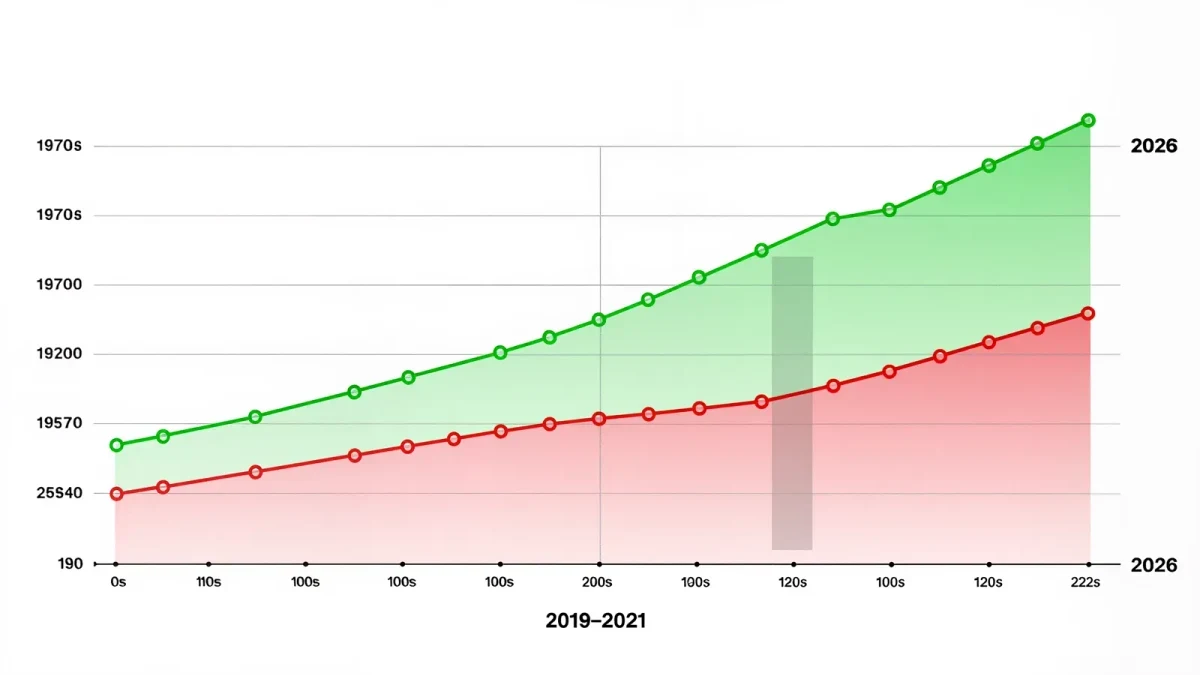
Nine-year-olds posted gains in both math and reading on the 2026 NAEP Long-Term Trend assessment, while thirteen-year-olds showed no significant change in either subject compared with 2023, per results released June 10, 2026 by the National Assessment Governing Board at nationsreportcard.gov. The divergence marks a split recovery for the nation's youngest and oldest tested age groups.
The Long-Term Trend assessment, administered to ages 9 and 13, is national-only and cannot be compared with the main Nation's Report Card. It is the longest-running measure of U.S. student learning, with trend lines back to the 1970s.
What do the teen results show?
For thirteen-year-olds, the flat 2026 scores extend a long stagnation: reading scores for the age group have shown no significant improvement since 1971, with double-digit declines since 1984. In math, average scores for thirteen-year-olds rose 21 points between 1978 and 2012 before progress stalled and reversed over the past decade.
The prior assessments, in 2022 for age 9 and 2023 for age 13, had shown declines across the board, making the 2026 flatline a stabilization rather than a recovery for teens.
Why are younger students recovering faster?
Analysts point to timing: today's nine-year-olds spent their foundational early grades largely in post-pandemic classrooms with intensive early-literary and math blocks, while current thirteen-year-olds were in upper elementary and middle school during the disruption, the years when NAEP historically captures skill consolidation.
Student habits also factor in. In 2023, only 14 percent of thirteen-year-olds reported reading for fun almost daily, the lowest level ever recorded and down 13 percentage points from 2012.
What does this mean for schools?
For districts, the results argue for sustaining middle school interventions rather than declaring pandemic recovery complete, since the teen cohort has now registered two consecutive flat or declining cycles. Results for the main 2026 assessments in grades 4 and 8 are scheduled for release in early 2027, which will show whether state-level patterns match the national age-based picture.
What is the Long-Term Trend assessment exactly?
Unlike the main NAEP, which tests grades 4, 8, and 12 and reports state results, the Long-Term Trend assessment tests nine- and thirteen-year-olds nationally and has kept its questions largely stable since the 1970s so scores can be compared across decades. It was suspended during the pandemic and returned earlier in the 2020s, with age 9 last assessed in 2022 and age 13 in 2023, both showing declines.
What should educators take from the split?
The gains among nine-year-olds line up with the years of federal recovery funding aimed at elementary reading and math, including tutoring and extended learning time, much of which has now expired. Thirteen-year-olds, by contrast, are absorbing the disruption into high school course-taking, where algebra readiness and sustained reading stamina compound.
The reading-for-fun statistic remains the most quoted warning sign in the trend data: fourteen percent daily reading among teens in 2023, the lowest ever recorded and thirteen points below 2012. Middle grades that rebuilt independent reading time have reported better engagement, and the 2026 results give that work new urgency.