School and career counselors earned a median of $61,710 per year as of May 2023, according to the U.S. Bureau of Labor Statistics, and entering the field almost always requires a master's degree in school counseling plus a state-issued credential. Pay runs from the mid-$40,000s in lower-paying states to six figures in well-funded districts, and requirements vary by state.
Treat this as information, not advice. Licensure titles, coursework mandates, and salary schedules differ by state and district, so confirm details with your state education agency and target districts before committing to a program.
What Does a School Counselor Actually Do?
The job has moved far beyond scheduling and college brochures. Modern school counselors run tiered academic advising, small-group interventions for anxiety or grief, classroom lessons on social skills, crisis response, and postsecondary planning. Most follow the model promoted by the American School Counselor Association, which caps the recommended caseload at 250 students per counselor.
Reality rarely matches the recommendation. Many states average 350 to 450 students per counselor, with some districts far higher, which is why workload is the first question to ask in any interview. The role is distinct from school psychologist, which emphasizes assessment and special education evaluation, and from school social worker, which centers family and community casework.
How Does the Pay Break Down?
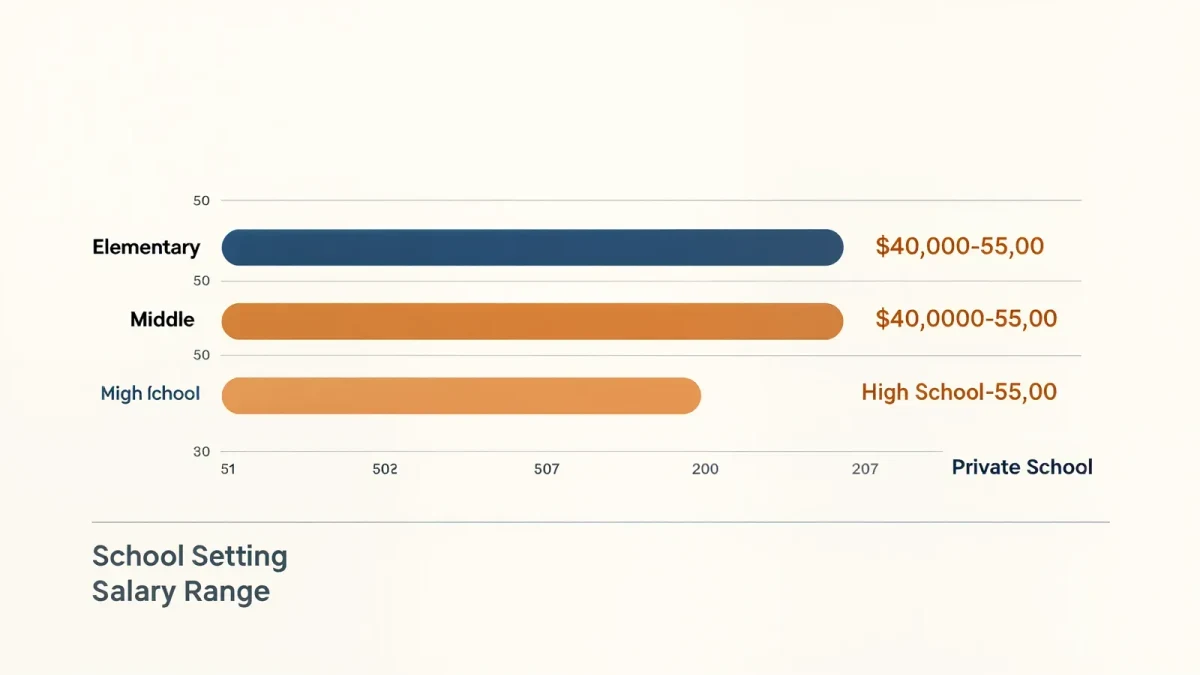
The BLS figure covers school and career counselors and advisors nationally as of May 2023. Where you land within the range depends mostly on geography and sector.
| Position in Range | Approximate Annual Pay | Typical Setting |
|---|---|---|
| Median, all school and career counselors (BLS, May 2023) | $61,710 | U.S. overall |
| Lower quarter | Roughly $50,000 and below | Elementary schools in lower-wage states; private schools |
| Upper quarter | Roughly $80,000 and above | Suburban districts in California, New York, New Jersey, Massachusetts |
| Top of scale | Low six figures | High-cost metros with long service or doctorate placement |
Two structural notes matter. Counselors are usually placed on the same salary schedule as teachers, with steps for years of service and lanes for graduate credits, so districts that pay teachers well pay counselors well. And because the credential transfers state-to-state only with reciprocity review, moving states can reset your placement.
What Are the Education and License Requirements?
The standard pathway is consistent across states even when the paperwork differs:
- Earn a bachelor's degree in any field; psychology, education, and sociology are common but not required.
- Complete a master's in school counseling, typically a 48-to-60 credit CACREP-accredited program including a 600-hour supervised practicum and internship in a school.
- Pass your state's required exam, which may be the Praxis School Counselor test or a state-specific assessment.
- Apply for the state credential, including a background check; some states add a teaching certificate or classroom experience requirement, and some do not.
- Clear entry requirements such as a mentoring period or induction hours where mandated.
The teaching-experience question is the biggest state-level variation. States such as California have historically required a pupil personnel services credential that may assume teaching background for certain authorizations, while many states certify counselors who have never taught. Check this before choosing a program, because it can add years to your plan.
Is the Job Market Growing?
The BLS projects roughly average growth for school and career counselors this decade, driven by rising demand for mental health support in schools and expanded college and career advising in the middle grades. Federal pandemic relief funding added many counseling positions, and the concern for job seekers is that some of those positions are soft when one-time money expires.
Demand also concentrates in specific places: rural districts, high-poverty schools, and districts with formal college-access programs tend to post openings repeatedly. If you are flexible on geography, the market is noticeably friendlier than the national average suggests.
Who Is This Career a Good Fit For?
Successful counselors tend to share a few traits: comfort with one-on-one emotional conversations, tolerance for interruption-driven days, and the discipline to document everything. Teachers transitioning into counseling often cite a wish to work with students more deeply; the trade-off is losing a classroom community while inheriting a caseload measured in hundreds.
Career changers from social work, human resources, and coaching backgrounds also transition in, but nobody skips the master's degree. That requirement is the field's main gate and its main cost, typically two years of full-time study.
How Can You Strengthen an Application?
A few moves reliably differentiate candidates in competitive districts. Volunteer for crisis-line or mentoring work before applying to programs, since admissions committees and later hiring panels weight direct experience. Choose a CACREP-accredited program because it smooths licensure portability and some states require it. During your internship, ask to co-facilitate groups rather than only observing individual sessions, and keep artifact evidence of a data-driven intervention, because modern hiring panels ask how you measured outcomes.
Finally, learn the vocabulary of multi-tiered systems of support, or MTSS, and of college-access metrics. Counselors are increasingly evaluated on attendance, discipline, and postsecondary enrollment data, and candidates who speak that language stand out.
Can Current Teachers or Career Changers Shorten the Path?
Teachers have one real shortcut: some graduate programs waive certain foundation courses for licensed educators, and a few districts fund counseling degrees through tuition partnerships in exchange for service commitments. A teacher who starts a part-time program while working can typically finish in three years without leaving the classroom.
Career changers from adjacent fields should audit their transferable credits carefully. Psychology graduates often satisfy research and human development coursework; human services veterans may place out of interviewing-skills classes. Programs vary widely in how generously they accept prior learning, so request a written transfer evaluation from at least three schools before enrolling anywhere.
One caution applies to online programs. Only a minority of fully online degrees arrange school-based internships in your area for you; most expect you to secure placement yourself, which can be awkward without school contacts. Ask programs directly how many of their distance students complete internships in their own communities.
How Does the Work Differ by Grade Level?
The credential covers kindergarten through twelfth grade, but the job differs sharply by level. Elementary counselors teach preventive classroom lessons on friendship and emotional regulation and spend heavy time on early behavioral concerns. Middle school counselors manage schedule changes, bullying response, and the first wave of academic tracking decisions. High school counselors carry graduation monitoring, college applications, financial aid questions, and the emotional turbulence that peaks around transitions.
The rhythm of the caseload shifts accordingly. Elementary work spreads across many brief contacts; high school work clusters into fewer, longer, higher-stakes conversations. Applicants who know which rhythm suits them tend to last in the field; those who discover a mismatch after hiring often burn out within three years. If you can, shadow one counselor at each level before choosing a program concentration.
What Is the Honest Bottom Line?
School counseling offers median pay in the low $60,000s, strong job stability, and school-year schedules, in exchange for a mandatory master's degree, heavy caseloads, and emotional labor. For people who want to work with young people without carrying a classroom, it remains one of the most accessible paths in education, provided you enter with clear eyes about the workload.