The American Association of School Librarians revised its national school library standards to explicitly include evaluating emerging technology and information sources, formalizing a role many media specialists were already filling informally: the person in the building best positioned to judge whether an AI research tool helps students find and evaluate information, or simply hands them an unsourced summary to copy.
This is a framework for that evaluation, not an endorsement of any specific product. Vendor claims about an AI tool's sourcing and accuracy are the vendor's own claims and should be tested against real student research tasks before a recommendation goes out.
What Makes AI Research Tools Different From a Search Engine?
A standard search engine returns links a student must open, read, and evaluate. Many AI research assistants instead generate a synthesized answer, sometimes with citations and sometimes without, that a student can accept without ever visiting a source. That shortcut is the entire appeal and the entire risk: it can save real time, and it can also let a student skip the evaluative step that information literacy instruction exists to teach.
The tools also vary enormously in whether their citations are real, current, and traceable. Several journalism and library-science reviews published in 2023 and 2024 found that some AI assistants generated citations to sources that did not say what the tool claimed, or that did not exist at all — a known failure mode researchers call hallucination.
What Should a Librarian Check Before Recommending a Tool to Students?
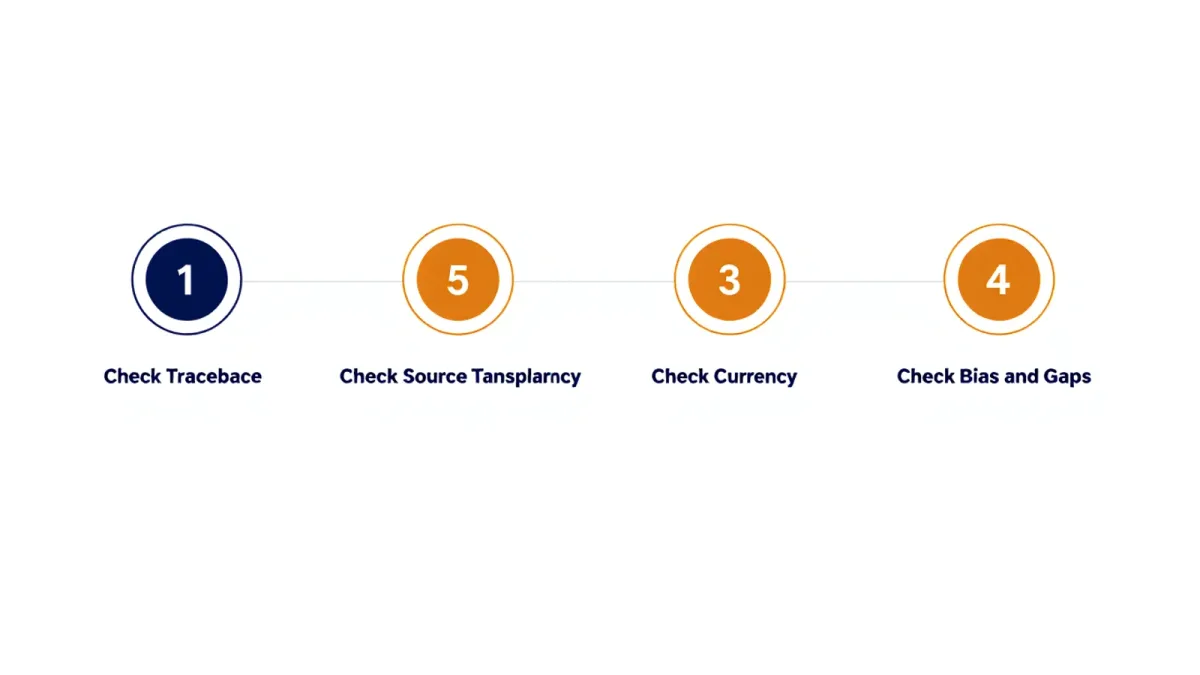
A working evaluation checklist covers four areas:
- Citation traceability. Pick five factual claims the tool generates and try to verify each one against the source it cites. A tool that fails this test even occasionally is not ready to hand to students without heavy scaffolding.
- Source transparency. Does the tool show which sources it drew from, or only a generated paragraph with no way to check? Tools that cite are meaningfully safer than tools that summarize with no attribution.
- Currency and scope. Some AI models draw on training data with a fixed cutoff and cannot reliably discuss recent events, a limitation that matters enormously for a current-events assignment.
- Bias and gaps. Run the same query on a topic with contested or underrepresented perspectives and see whether the tool surfaces a single dominant framing or a range of sourced viewpoints.
How Should Information-Literacy Instruction Change?
Media specialists who have piloted AI research tools with classes report that the more durable teaching move is not banning the tools but making the evaluation step explicit and graded: students must submit the AI-generated answer alongside their own verification of at least two claims against primary sources, with citations they checked themselves. That assignment structure treats the AI output as a draft to interrogate, not a finished answer, and it directly targets the skill — source evaluation — that a synthesized answer otherwise short-circuits.
Several district library programs have also adopted a simple rule that survives contact with fast-moving tools: no AI-generated citation goes into a bibliography until a student has opened and confirmed the actual source. That single check catches the hallucinated-citation problem regardless of which specific tool a student used.
What Belongs in a Written Policy for the Library?
A workable library AI-use policy states plainly which tools are approved for which grade bands, what data the tool collects on student queries and whether that use is compliant with the district's student-data agreements, and what the verification requirement is before any AI-sourced claim can appear in a student's cited work. Policies written without a verification requirement tend to collapse the first time a student submits a paper built on a fabricated citation, because there is no established process for catching it.
Should a Library Simply Wait for Better Tools?
Waiting has a cost: students are already using these tools outside library guidance, often without any instruction in verification at all. Media specialists who ran early pilots generally concluded that structured, supervised use — with the verification step built into the assignment — taught more information-literacy skill than either an outright ban, which pushed use further outside instruction, or unstructured access, which taught none.