The National Association for College Admission Counseling, which publishes an annual State of College Admission report drawing on survey data from admission offices nationally, has tracked the rapid spread of test-optional admission policies since most institutions adopted them out of pandemic necessity in 2020 and 2021, and the subsequent, more deliberate decisions by individual institutions about whether to make the policy permanent, revert to requiring scores, or move to test-blind admission entirely. A handful of highly selective institutions reinstated testing requirements in 2023 and 2024, citing internal research on predictive validity, while many others made test-optional policies permanent, and NACAC's data shows the field genuinely split rather than converging on a single answer.
This is a framework for how enrollment leaders have approached the decision, not a recommendation on any specific institution's policy, since the right call depends heavily on an institution's own applicant pool, mission, and the research it can conduct on its own data.
What Does the Research Actually Show About Predictive Validity?
Institutions that reinstated testing requirements generally cited internal research finding that standardized test scores, used alongside high school GPA, improved the ability to predict a student's college academic performance compared to GPA alone, particularly for identifying strong students from high schools without extensive AP or honors course offerings whose transcripts otherwise carry less comparative information for an admission office to evaluate. Institutions that kept test-optional policies permanent generally point to their own data showing minimal or no difference in the academic performance of admitted students who submitted scores versus those who did not, alongside evidence that requiring tests can suppress applications from lower-income and first-generation students who face real barriers to test preparation and testing access.
Both findings can be true simultaneously at different institutions, since predictive validity depends heavily on the specific applicant pool, the range of scores that pool actually produces, and how heavily an institution weighs test scores relative to other factors in its own admission model.
What Does Test-Optional Actually Change in Practice?
NACAC's tracking data shows test-optional policies have generally increased application volume, since some students who would have self-selected out of applying under a testing requirement now apply, which by itself changes an institution's yield and selectivity metrics independent of any change in academic outcomes. What test-optional policies have not consistently done, according to the broader research base, is meaningfully change the demographic composition of the enrolled class at every institution that adopted them — some institutions saw diversity gains, others saw little measurable shift, a variation that appears to depend heavily on how the institution paired the policy with other recruitment and financial-aid changes, rather than the testing policy alone.
What Should an Institution Actually Study Before Deciding?
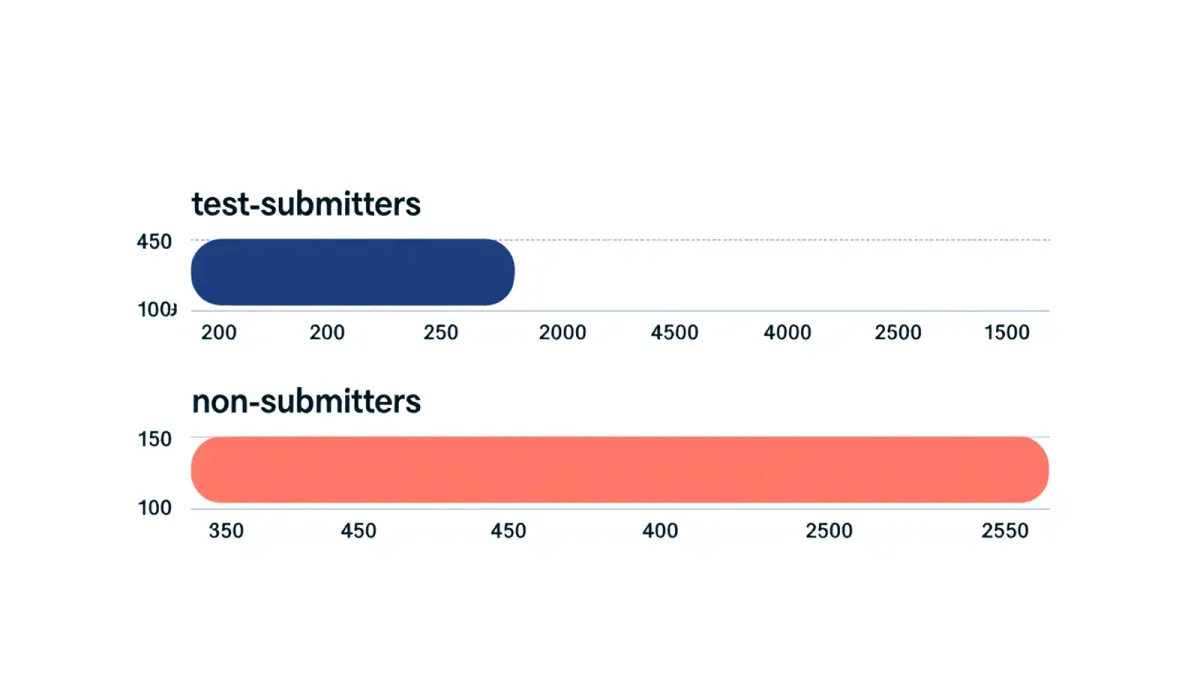
An enrollment office weighing a permanent decision should run its own predictive-validity analysis on several years of its own admitted-student data, comparing the academic performance of test-submitters and non-submitters, rather than relying on national research that may not reflect the institution's specific applicant pool and academic programs. It should also examine application and yield data by demographic group across the test-optional period, since the policy's effect on access is the empirical question most directly relevant to an institution's own mission, separate from the predictive-validity question.
Is Test-Blind Different From Test-Optional, and Does That Matter for the Decision?
Test-blind admission, where scores are not considered even if submitted, is a distinct policy from test-optional, where scores are considered if a student chooses to submit them, and the two carry different tradeoffs: test-blind removes any possibility that a submitted score advantages a student, but also removes it as a data point for students whose transcripts would otherwise benefit from it, such as a strong student at an under-resourced high school with limited AP offerings. NACAC's data shows most institutions that adopted test-optional policies during the pandemic stayed test-optional rather than moving to test-blind, suggesting most enrollment offices still see some value in the option even where they do not require it.
How Should an Institution Communicate Whatever It Decides?
Whichever direction an institution moves, publishing its own predictive-validity findings, where the research was conducted, gives applicants and counselors a clearer basis for the decision than a policy announcement without supporting evidence, and it protects the institution against the reasonable criticism that the decision was driven by enrollment-management optics rather than an actual assessment of what the tests do or do not predict for that specific applicant pool.