Yes, you can teach at a community college without a doctorate: regional accreditation standards generally require a master's degree plus at least 18 graduate credit hours in the subject you teach, which is why most community college faculty hold a master's, not a PhD. Postsecondary teachers overall earned a median of $84,380 as of May 2023, per the U.S. Bureau of Labor Statistics, but that figure conceals an enormous split between full-time faculty and per-course adjuncts, and hiring norms vary by state and field.
Treat this as information, not advice. Minimum qualifications, union contracts, and hiring markets differ by college, discipline, and state, so verify the specific requirements in job postings before planning around them.
What Qualifications Do Colleges Actually Require?
The master's-plus-18 rule comes from accreditation expectations for faculty qualifications: instructors teaching credit-bearing courses need a master's degree with a concentration, typically 18 graduate credits, in the discipline taught. A master's in English qualifies you to teach composition; an MBA with enough graduate accounting credits may qualify you for accounting courses specifically.
Three practical wrinkles matter:
- Professional fields are more flexible. Nursing, automotive technology, welding, culinary arts, and allied health programs often accept licenses plus industry experience in place of graduate credits, sometimes with a mandate to finish a degree within a set period.
- Developmental education has its own rules. Some states set separate qualifications for remedial and adult basic education courses.
- Full-time tenure-track jobs are the exception. Doctoral holders compete for them even at two-year colleges in transfer disciplines, though applied and technical fields still hire practitioners.
What Does the Work Pay?
The money question has two very different answers depending on the appointment type.
| Appointment Type | Typical Compensation | Notes |
|---|---|---|
| Adjunct, per course | Roughly $2,000-$5,000 per three-credit course | No benefits in most cases; pay set by union scale in organized states |
| Full-time instructor (non-tenure-track) | Often mid-$50,000s to mid-$70,000s | Benefits and load security; contracts renewed annually in many systems |
| Tenure-track faculty at community colleges | Commonly $60,000-$95,000 by region and field | Competitive; doctoral or terminal degrees increasingly common in transfer subjects |
| All postsecondary teachers (BLS median, May 2023) | $84,380 | National figure across all institution types, including research universities |
The per-course and salary figures above are ranges commonly seen in public postings and union schedules rather than a single national statistic; only the BLS median is one. Adjuncting rarely adds up to a living wage as a sole income, so most adjuncts either teach part-time alongside another job or string together courses across multiple colleges.
What Is the Hiring Process Like?
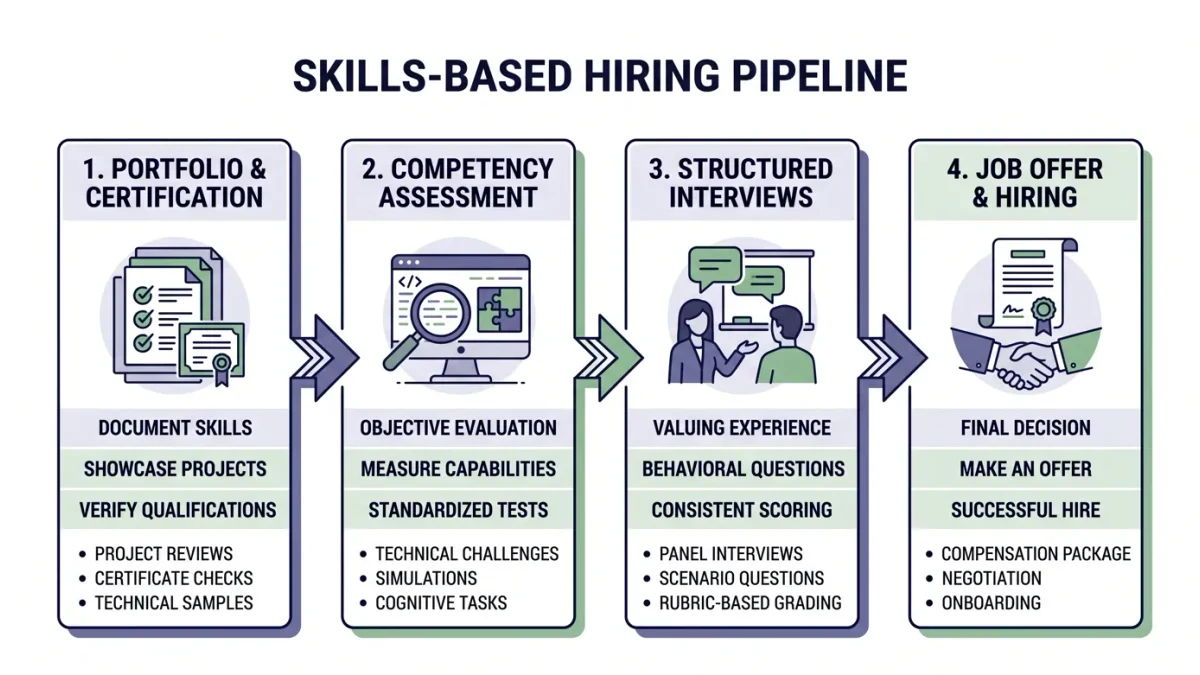
Community college hiring is committee-driven and slower than industry, usually running two to four months from posting to offer. Expect a written application with transcripts, a teaching demonstration in front of a search committee, and scenario questions about working with academically underprepared students. The teaching demo carries disproportionate weight, because committees assume your credentials and evaluate whether you can actually explain material to a mixed-ability room.
Student-centered evidence matters more than research. Where university hiring asks about publications, two-year colleges ask about retention strategies, office-hours philosophy, and experience with first-generation students. Applicants who frame their materials entirely around scholarship tend to stall; those who foreground teaching results advance.
How Do You Break In Without an Academic Network?
A reliable sequence looks like this:
- Confirm your transcript meets the master's-plus-18 requirement in a target discipline; request a graduate transcript audit if unsure.
- Apply specifically for adjunct postings in high-demand subjects: composition, math, English language learning, and allied health are chronically short-staffed.
- Apply in the spring and early summer for fall sections, since department chairs finalize schedules late.
- Deliver an over-prepared first semester; rehire depends heavily on enrollment and evaluations.
- After two or three strong semesters, ask the department chair directly what full-time openings typically require in that system.
High school teachers should check dual-credit partnerships too. Many states let experienced high school teachers qualified under the same graduate-credit rule teach college courses in their own building, which is often the smoothest first community college contract available.
What Are the Realistic Career Arcs?
Three arcs dominate. The practitioner arc: professionals from nursing, IT, trades, or business teach part-time for engagement and a modest supplement, with no intention of going full-time. The adjunct-to-faculty arc: teachers who build course history and then compete for full-time instructor roles, a path that works best in applied and technical fields where practitioners are scarce. And the graduate-student arc: master's students who adjunct while deciding whether to pursue a doctorate.
Full-time community college faculty positions attract dozens to hundreds of applicants per opening in humanities and social sciences. The odds improve sharply in nursing, welding, automotive, HVAC, and other technical fields, where industry pay outcompetes colleges for qualified candidates.
Is It Worth It Compared to K-12 Teaching?
Compared with a public school contract, community college teaching offers no parent communication at scale, no bell schedule discipline duties, and students who chose to enroll. It trades those away job security in the adjunct ranks, since per-course appointments guarantee nothing semester to semester, and in most states no K-12-style pension unless the college participates in the same system.
For current teachers, the honest comparison is usually supplemental: dual-credit or evening sections taught alongside a school contract, or a summer course. Adjunct pay per hour, once prep and grading are counted, is frequently below a teacher's hourly rate. The compensation is professional: college-level teaching experience, a curriculum vitae entry, and a foothold should a full-time opening appear.
What Fields Have the Most Openings?
Demand tracks what students enroll in and what industries cannot staff. Composition and developmental math remain the largest single hiring categories, because nearly every credential requires them. English language learning programs keep recruiting in immigrant-serving regions. Allied health is a category of its own: nursing programs across the country turn away qualified applicants chiefly because they cannot hire enough instructors, which makes nursing one of the few fields where a master's plus a clinical license approaches a guaranteed market.
Technical education is the sleeper. Welding, automotive, HVAC, aviation maintenance, and construction trades programs pay industry-adjacent adjunct rates and still struggle to staff, since qualified practitioners often earn more outside education. A mid-career tradesperson with an associate degree and a license can sometimes negotiate qualification exceptions that would be unthinkable in academic departments.
By contrast, history, psychology, and sociology adjunct pools overflow with graduate degree holders, so postings in those fields draw large applicant slates within days. Choose your discipline with this map in mind, not just your passion for the subject.
What Should You Do First?
Start with your transcript and one target discipline, not with applications. Get an official graduate transcript, count credits in the discipline, and identify the two or three subjects where you are unambiguously qualified, because committees reject candidates whose qualification case they have to assemble themselves. Then watch postings from your local colleges for one hiring cycle before applying, so you learn which departments post repeatedly and what they emphasize.
The door is genuinely open at the master's level, and in technical fields it is propped wide. Just walk in knowing which side of the pay table you are entering.